Skip to content
Boulder County · Base of the Flatirons

Boulder Real Estate

The Front Range's original icon — and one of the most distinctive cities in the country.

Boulder real estate is unlike anywhere else in Colorado. Home to the University of Colorado, five federal labs, the iconic Flatirons, and the first U.S. city ever to tax itself for open space conservation. Boulder is structurally limited in size by 45,000 acres of protected land, a strict height-limit ordinance, and growth-management policies — which makes its neighborhoods rare, character-driven, and worth knowing in detail.

Boulder market — spring 2026

A balanced Boulder market

The Boulder real estate market is more even-handed than the 2021–2022 frenzy years. Inventory has recovered, prices vary meaningfully by neighborhood, and serious buyers have real room to negotiate. Here's the citywide snapshot — see the individual neighborhood breakdowns below for more granular pricing.

$819k–$1.0M Median Sale Price Varies by source & property type
39–52 Days on Market Median typically 45–50 days
~96–97% Sale-to-List Ratio Well-priced homes still close near list
6.4–6.9% Mortgage Rates Conventional 30-year, spring 2026

Sources: REcolorado MLS, Redfin, Zillow, Movoto, Houzeo — spring 2026. Single-family homes commonly $1.2M–$1.5M; condos and townhomes typically $450k–$550k. Updated quarterly.

Things you might not know

Boulder's hidden history

Boulder is a city of firsts — civic milestones, architectural landmarks, and quirky cultural traditions that explain why a 35-foot-tall city of 100,000 has the gravitational pull of a much bigger metro. Several facts are neighborhood-specific; we've tagged them so you can see where the stories live.

Boulder1967

First U.S. city to tax itself for open space

In 1967, Boulder became the first city in the United States to pass a dedicated sales tax to acquire and preserve open space. The program has since protected more than 45,000 acres surrounding the city — creating a hard geographic growth boundary that no other Front Range city has.

BoulderFlatirons

An icon taller than the Empire State Building

The face of the Third Flatiron rises more than 1,400 feet from base to summit — taller than the Empire State Building's roofline (1,250 feet). Boulder is one of the only U.S. cities where a rock formation in the city limits is taller than New York's most famous skyscraper.

BoulderCulture

America's highest per-capita used bookstore density

Boulder has consistently ranked among the cities with the highest per-capita concentration of used bookstores in the United States. Pair that with 5 federal labs, the University of Colorado, and one of the highest PhDs-per-capita rates in the country — and you get a city that takes reading seriously.

Boulder's oldest standing home

The Squires-Tourtellot House at 1019 Spruce Street was built in 1865 from local river rock and fieldstone with 20-inch-thick walls. It was the first building ever landmarked by the City of Boulder — predating the city's incorporation by six years.

A neighborhood built around a school

Unlike most developments that add schools later, Mapleton Hill's very first building was the Mapleton School in 1888. The neighborhood grew up around it. The building still operates as a school today — over 135 years later.

The accidental cathedral canopy

In the 1880s, developers planted more than 200 silver maple and cottonwood trees on what was then a barren, windswept hill. Famed landscape architect Frederick Law Olmsted Jr. later dismissed silver maples as too brittle — "a poor choice." More than a century later, the trees still stand, creating a rare East-Coast-style cathedral canopy in the Mountain West.

Mapleton HillColonial Revival

The Wedding Cake House

1020 Mapleton Avenue earned its nickname from an elaborate, multi-tiered Colonial Revival design that resembles tiers of a wedding cake. One of Boulder's most photographed homes — and a benchmark for the architectural ambition that defines the historic district.

One of America's earliest pedestrian malls

The Pearl Street Mall opened in 1977, making it one of the earliest pedestrian-only retail districts in the United States. Four blocks of historic buildings, street performers, public art, and locally-owned businesses — it's been the heart of Boulder for nearly five decades.

DowntownCivic quirk

Pearl Street is officially a city park

The four-block car-free strip of Pearl Street isn't classified as a shopping center, a plaza, or a public square — it's officially designated as a City of Boulder park. Bands on the Bricks summer concerts, pop-jet fountains, public rock gardens, and street performers all happen on what is, legally, parkland.

The first paved road in Boulder

Pearl Street was the first road ever paved in Boulder, in 1917. The bricks underfoot — replaced and restored multiple times since the 1977 pedestrian-mall redesign — literally cover Boulder's earliest piece of modern paved infrastructure.

DowntownMulti-generational

Generations of independent businesses

Pearl Street is home to multi-decade Boulder institutions: Hurdle's Jewelry has operated since 1947, Boulder Bookstore since 1973, and Into the Wind (the kite and toy shop) for decades. In an era when most American downtowns turn over rapidly, Pearl Street's tenant longevity is one of the longest in the country.

Table Mesa1967 · I.M. Pei

An I.M. Pei masterpiece above the neighborhood

The NCAR Mesa Lab, sitting at the top of Table Mesa, was designed by modernist architect I.M. Pei (later famous for the Louvre Pyramid). Completed in 1967, the bush-hammered poured-concrete structure was designed to feel like a natural extension of the Flatirons behind it — one of Pei's most respected institutional buildings, and the visual anchor of South Boulder.

Table MesaEarly 1960s

A shopping center built around its trees

When the Table Mesa Shopping Center was developed in the early 1960s, the architects didn't clear the existing trees — they designed the structure around them. Two massive original trees still pierce through the shopping center's roof line today, a living tribute to the neighborhood's pre-development character.

Chautauqua1898 · Texas-Colorado

Founded for Texas teachers escaping the heat

The Colorado Chautauqua was originally created as a summer school destination for educators from Texas seeking a cool mountain climate. The governing nonprofit was formerly known as the Texas-Colorado Chautauqua Association — the only chapter of the national 19th-century Chautauqua adult-education movement to take root west of the Mississippi River.

ChautauquaNational Historic Landmark

The last Chautauqua west of the Mississippi

The Colorado Chautauqua is the only Chautauqua west of the Mississippi River still in unbroken operation since the heyday of the Chautauqua Movement in the 1920s. Designated a National Historic Landmark in 2006, it joins just a small number of original Chautauquas nationwide still operating with their 19th-century structures intact.

Chautauqua1898 Auditorium

Where William Jennings Bryan spoke

The Chautauqua Auditorium (1898) hosted some of America's most famous orators in its heyday, including three-time presidential candidate William Jennings Bryan. The wooden hall is voted among the top ten places artists love to play because of its superior acoustics and intimate feel — still hosting summer concerts and silent-film screenings today.

University HillThe student capital

More college students per block than 99.6% of America

"The Hill," the neighborhood immediately west of the CU Boulder campus, has a greater concentration of college-enrolled residents than 99.6% of all U.S. neighborhoods. Greek Row, restored Victorians, and converted student rentals fill the streets — a five- to ten-minute walk from central campus.

University Hill1960s & 70s

Boulder's rock & roll counterculture epicenter

During the 1960s and 70s, the Hill was the center of Boulder's rock-and-roll and counterculture movements. The legendary Tulagi music venue hosted major touring acts — and in the same era, several former fraternity houses were converted into Buddhist meditation communities, a pivot that remains classically Boulder.

University HillMercury 7 alum

The astronaut who grew up at 7th & Aurora

Mercury 7 astronaut Scott Carpenter — the second American to orbit Earth aboard the Aurora 7 capsule in 1962 — grew up at the corner of Aurora Avenue and 7th Street on the Hill. He attended University Hill Elementary as a child (where he reportedly carved a wooden toy train for a classmate in 1934) before graduating from Boulder High and CU's aeronautical engineering program. Aurora 7 Elementary in the Aurora 7 neighborhood east of campus is named for his spacecraft.

Whittier1882 · Historic Landmark

Colorado's oldest continuously operating school

Whittier International Elementary at 2008 Pine Street, originally the Pine Street School, opened in 1882 with 135 students in four classrooms. More than 140 years later it's still operating, making it the oldest continuously operating school in Colorado. The building itself is a designated Historic Landmark.

Whittier1903 · A poet wrote back

A 6th-grader, a fan letter, and a renamed school

In 1903, a 6th-grade student named Effie Titus wrote a fan letter to poet John Greenleaf Whittier about his poem "Snowbound." Whittier wrote back, beginning a correspondence between the poet and the school — and the Pine Street School was renamed in his honor. The neighborhood took its name from the school. A 12-year-old's pen pal letter is how an entire Boulder neighborhood got its identity.

NoBoThe "Brooklyn of Boulder"

From industrial zone to Colorado Creative District

North Boulder ("NoBo") evolved over the last 20 years from a working industrial corridor north of Iris Avenue into Boulder's unofficial arts hub — earning the nickname "the Brooklyn of Boulder." The NoBo Art District is officially designated a Colorado Creative District, with dozens of galleries, working studios, and monthly First Friday art walks where the public meets the artists.

NoBoCultural diversity

Boulder's most culturally diverse neighborhood

The blocks of North Boulder east of Broadway hold the largest Latinx population in Boulder, adding cultural and culinary diversity that distinguishes NoBo from neighborhoods elsewhere in the city. In a city often criticized for demographic homogeneity, NoBo is a meaningful exception.

NoBoWonderland Lake

A lake inside the city, ringed by foothills trails

Wonderland Lake Park sits inside North Boulder — a scenic urban lake with surrounding trails that connect directly to the foothills open space network. Residents can walk out the front door to a foothills hike or a quiet lakeside picnic, which is rare even by Boulder's high outdoor-access standards.

BoulderToday

Five federal labs and a PhD city

Boulder hosts NIST (atomic clock and time-standard research), NOAA (weather and climate), NCAR (atmospheric research, in I.M. Pei's iconic mesa building), the Joint Institute for Laboratory Astrophysics, and supports the National Renewable Energy Lab in nearby Golden. Combined with CU Boulder, this gives the city one of the highest concentrations of PhDs per capita in America.

Boulder's strawberry-and-fruit farm

Newlands is named for the Newland family, who established a large fruit and strawberry farm here in the 1870s. When Mary Newland began selling parcels to developers in the 1890s and early 1900s, the orchard heritage stayed embedded in the neighborhood's character — and in some of its still-standing original homes.

Newlands1890s legend

An apple tree on every lot

Local lore holds that the Newland family planted an apple tree on every parcel they sold off, hoping to add value and signal abundance to potential buyers. Some of those trees are believed to still bear fruit on Newlands lots today — living artifacts of the neighborhood's agricultural beginnings.

One of Boulder's most organized neighborhoods

Newlands is one of the only Boulder neighborhoods with its own hyper-local volunteer community organization. Active social media pages coordinate seasonal events, garden tours, and neighborhood initiatives — a level of grassroots civic infrastructure rare in a city of Boulder's size.

What makes Boulder, Boulder

Why Boulder is unlike anywhere else

Boulder isn't trying to be the next anything. The city's character is the product of decades of deliberate civic choices — protecting open space, capping building height, prioritizing pedestrians, investing in research. Here's what shapes the daily experience of living here.

45,000 Acres of Protected Land

Boulder's open space program — the first in the U.S. funded by dedicated sales tax (1967) — now protects more than 45,000 acres surrounding the city. It's why Boulder can't sprawl, why prices stay high, and why trailheads are minutes from every neighborhood.

University & Federal Labs

The University of Colorado Boulder, five federal research labs (NIST, NOAA, NCAR, JILA, plus NREL nearby), and an exceptional density of PhDs per capita. Tech, biotech, aerospace, and climate research are the local industries — not commodity employers.

Flatirons Out Every Window

The iconic Flatirons rise dramatically from the western edge of the city. Almost every west-facing window in Boulder frames them. Mountain access is measured in minutes — Chautauqua Park, NCAR Mesa Trail, and Mount Sanitas are all in the city limits.

Pearl Street & Walkable Downtown

One of America's earliest pedestrian malls (1977). Four blocks of locally-owned restaurants, shops, bookstores, and the Boulder Theater. Year-round street performers, public art, and a Friday-night energy that draws all of Boulder County in.

35-Foot Height Limit

Boulder's strict building height ordinance keeps the skyline low — almost no buildings exceed 35 feet. The result: views stay open, neighborhoods stay residential in scale, and the city has resisted the high-rise density of the broader Denver metro.

A City Built on Books and Bikes

Among the highest used-bookstore density per capita in the U.S. Hundreds of miles of bike paths and lanes. Boulder consistently ranks in the top 5 most bike-friendly U.S. cities — you can cross town without ever sharing a road with a car.

Public schools — the BVSD advantage

One district, 56 schools

Schools matter to Boulder real estate values, and Boulder is served by Boulder Valley School District (BVSD), which operates 56 schools across Boulder and nearby communities and consistently ranks among Colorado's top districts. Unlike Longmont's SVVSD, BVSD uses address-based attendance areas for neighborhood schools — your home determines which elementary, middle, and high school your child is zoned for.

BVSD also operates several focus schools (High Peaks for Core Knowledge curriculum, Community Montessori, Boulder Community School of Integrated Studies) that accept students from anywhere in the district via lottery. The two main Boulder high schools are Boulder High (north and central) and Fairview High (south Boulder, served by Table Mesa and Chautauqua-area neighborhoods).

Attendance areas are reviewed and occasionally redrawn — BVSD is making boundary adjustments effective 2026–27. Always verify school assignments for a specific address via the BVSD SchoolFinder tool at bvsd.org before relying on them.

56 Schools across BVSD
A− Niche district grade — top of Colorado
2 Main Boulder high schools: Boulder & Fairview
Neighborhoods we know

Eight Boulder neighborhoods, eight personalities

Boulder real estate is bigger and more textured than the city's 100,000 population suggests. We've featured Mapleton Hill in depth — it's the most distinctive of Boulder's neighborhoods and demands a real treatment — then introduced seven more, each with its own character, market position, and lifestyle. Specific market data and schools are at the bottom of the page.

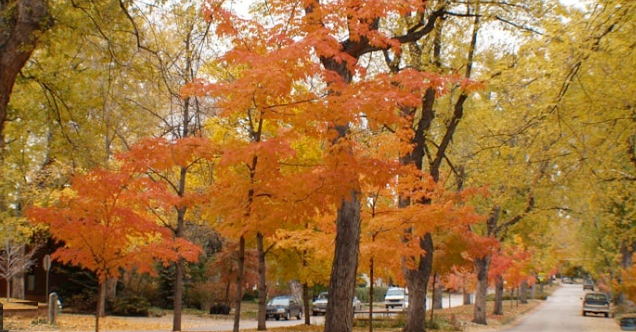
Boulder real estate — Mapleton Hill historic district with iconic silver maple cathedral canopy in autumn
Mapleton Hill's silver maple canopy in autumn — planted in the 1880s on what was then a barren, windswept hill, and somehow still standing more than 140 years later.
Featured · Historic Prestige

Mapleton Hill

Boulder's largest historic district — celebrated for its architectural diversity, sweeping elevated views, and deep-rooted civic history. Perched just northwest of downtown, Mapleton Hill blends a Norman Rockwell aesthetic with unique historical trivia at every block.

Mansions in Victorian, Queen Anne, and Foursquare styles line tree-canopied streets within walking distance of Pearl Street and steps from the Mount Sanitas trailhead. Inventory is tight — historic protections limit new construction, and listings here regularly draw multiple offers when they hit the market.

Architectural Showcase
Queen Anne & Victorian Turrets, asymmetric facades, ornate trim. The neighborhood's signature style, concentrated on the south end.
Colonial Revival Symmetrical, classical proportions. The "Wedding Cake House" at 1020 Mapleton is the icon.
Tudor Revival Steep roofs, half-timbering, decorative European detail. Less common but present.
Foursquare & Edwardian Practical, full-width porches, durable craftsmanship. Concentrated near the north end of the district.
The 5-Minute Walk Lifestyle
5 min east →
Pearl Street Mall
Fine dining, locally-owned shops, street performers, the Boulder Theater. Boulder's cultural heart.
← 5 min west
Mount Sanitas Trailhead
Rugged foothills hike, 1,255 feet of elevation gain, panoramic Front Range views. A local favorite for sunrise.
Landmarks Board Navigator
What to know before you remodel

Mapleton Hill is an official historic district (designated 1982, expanded 2002). Any exterior change — including window replacement, paint color in some cases, fences, accessory buildings, or structural modifications — requires a Landmark Alteration Certificate (LAC) from Boulder's Landmarks Board.

Interior renovations generally don't require LAC approval. Tax credits available: Colorado offers a 20% state income tax credit on qualified historic rehab (up to $50,000 per property), and Boulder waives sales tax on certain exterior construction materials for historic homes.

Top nearby schools Whittier International Elementary (IB program, oldest school in Boulder County), Casey Middle, and Boulder High serve much of Mapleton Hill. Verify your address with BVSD SchoolFinder before relying on assignments.
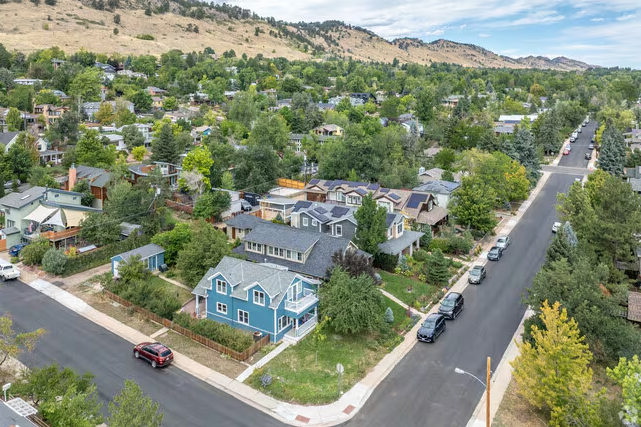
Newlands neighborhood in north-central Boulder, Colorado — aerial view showing residential streets backed by the Mt. Sanitas foothills
Newlands from above — the Mt. Sanitas foothills frame the neighborhood directly to the west, the source of the trailhead access residents value most.
Coveted · North Boulder

Newlands

A highly coveted, affluent enclave in north-central Boulder, named for the Newland family whose 1870s fruit and strawberry farm covered the land. Mary Newland began selling parcels to developers in the 1890s — and the neighborhood's orchard origins are still woven into its character.

Today Newlands offers a small-town feel within easy walking distance of Pearl Street Mall. Properties routinely fetch median sale prices in the multi-million-dollar range, and the area's demographic is among Boulder's most educated — over 86% of adults hold a bachelor's degree or higher.

Architectural Diversity
Restored 1920s cottages The neighborhood's earliest housing stock, lovingly preserved or carefully updated.
Post-war bungalows Family-scaled homes built when North Boulder Park was the neighborhood's center of gravity.
Mid-century modern Clean lines, low rooflines, indoor-outdoor flow — the Boulder vernacular of the 1950s and 60s.
Sleek new custom builds Contemporary architect-designed luxury, often built on infill lots or as careful tear-down-and-replace projects.
Why People Move Here
Trails ↑
Mt. Sanitas & Red Rocks
Newlands sits directly at the base of the foothills — immediate doorstep access to the Mt. Sanitas trail network and Red Rocks for hiking and mountain biking.
Walk · Bike →
Ideal Market & Pearl Street
Walking or biking distance to the Ideal Market shopping center (a Boulder staple for specialty groceries and coffee) and to the Pearl Street Mall.
Community Character
One of Boulder's most organized neighborhoods

Newlands has its own hyper-local volunteer community organization and an active social media presence that champions seasonal events, garden tours, and neighborhood initiatives.

The neighborhood is flanked by the expansive North Boulder Park and a short trip from the North Boulder Recreation Center — ample green space and recreation infrastructure within a 10-minute walk of most homes.

Top nearby schools Foothill Elementary School (a longstanding neighborhood school since 1949), Casey Middle School, and Boulder High School serve Newlands. Many families also consider Shining Mountain Waldorf School, located directly on Violet Avenue in the neighborhood. Verify your specific address with BVSD SchoolFinder before relying on assignments.
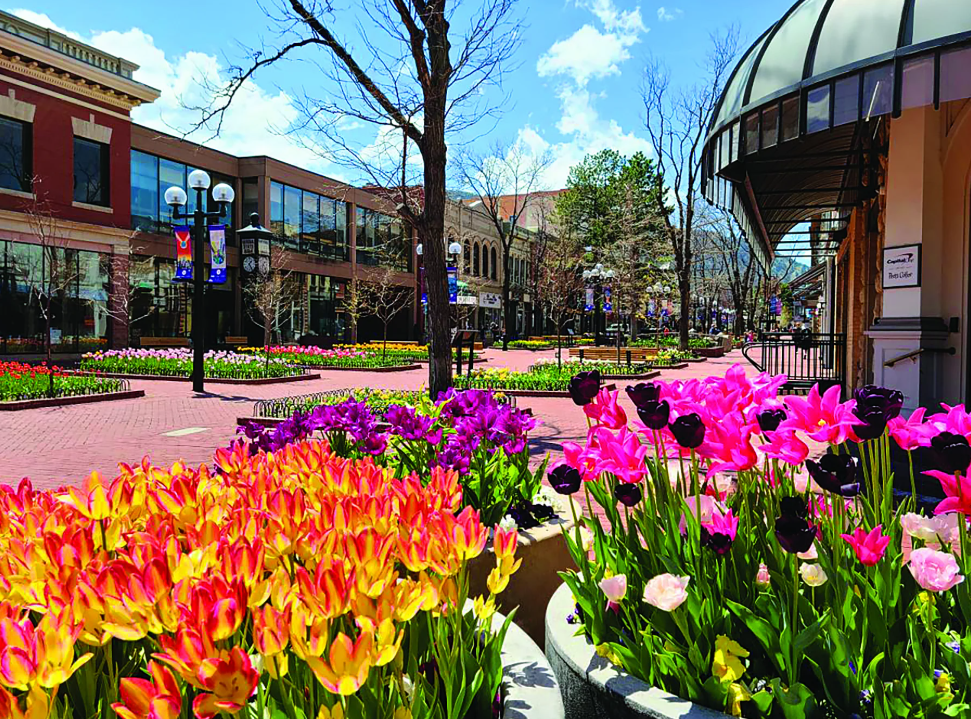
Pearl Street Mall in downtown Boulder, Colorado — brick pedestrian walkway with spring tulips in bloom and historic storefronts
Spring tulips on the Pearl Street Mall — officially a Boulder city park (not a shopping center), four blocks of car-free brick paving since 1977.
Walkable Urban · Historic

Downtown & Pearl Street

A vibrant, historic pedestrian haven at the foot of the Flatirons. Pearl Street Mall — the four-block car-free strip at the heart of downtown — anchors a neighborhood of nearly 100 acclaimed restaurants, coffee shops, and boutiques, all wrapped in beautifully preserved 19th-century Victorian architecture listed on the National Register of Historic Places.

The downtown core attracts residents drawn to entrepreneurial energy, Michelin-recognized dining, and the rare luxury of stepping out their door into a four-block pedestrian-only mall. Inventory is a mix of historic condos in converted Victorian buildings, modern lofts above retail, and a small number of detached homes on side streets — all within walking distance of Pearl Street's restaurants and the bike paths that connect directly to the Flatirons trailheads.

Historic Roots
Officially a city park The four-block pedestrian strip of Pearl Street isn't just a shopping center — it's officially designated as a Boulder city park.
Boulder's first paved road Pearl Street was the first road ever paved in Boulder, in 1917 — a piece of infrastructure history walked on daily.
National Register of Historic Places Downtown Boulder is listed on the National Register, preserving its 19th-century Victorian architecture. Some exterior changes may require LAC approval.
Multi-generational businesses Home to Hurdle's Jewelry (1947), Boulder Bookstore (1973), and the legendary toy and kite shop Into the Wind — multi-decade local institutions.
The Pedestrian Lifestyle
Step out →
Pearl Street Mall
Nearly 100 restaurants, street performers, public art, the pop-jet fountains and rock gardens. Summer brings the renowned Bands on the Bricks outdoor concert series.
Bike paths ↻
Boulder Creek Path → Flatirons
A 2-mile bike and hike trail connects directly from downtown to the foothills, making car-free mountain access genuinely practical — a paradise for alternative transportation.
Top nearby schools Downtown Boulder addresses are served by Boulder Valley School District (BVSD) with neighborhood attendance areas varying by specific block. Most downtown core residential blocks fall within the Whittier International Elementary (IB program, oldest school in Boulder County), Casey Middle, and Boulder High feeder. Note: University Hill Elementary ("Uni Hill") — the popular dual-language Spanish/English focus school nearby — has no attendance area and is available to any BVSD family via the open enrollment lottery, not by address. Always verify your specific address with BVSD SchoolFinder before relying on assignments.
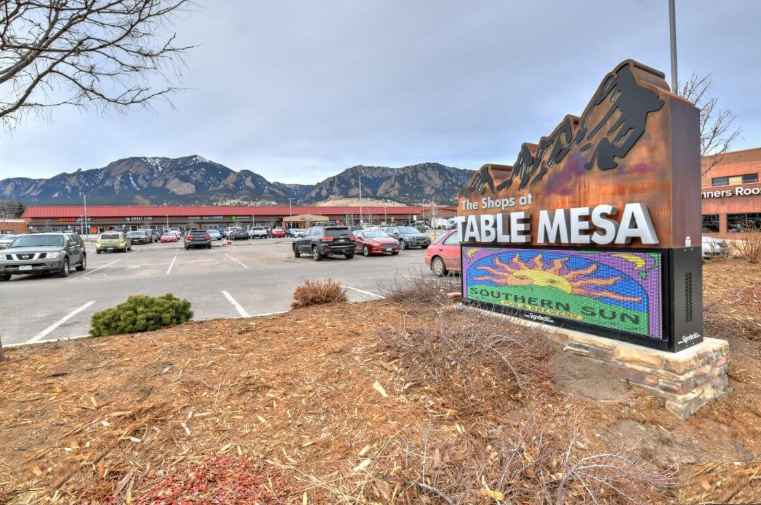
The Shops at Table Mesa in South Boulder, Colorado — the early-1960s shopping center monument sign with Southern Sun Pub marquee and the Flatirons rising behind
The Shops at Table Mesa — the neighborhood's social anchor, with Southern Sun Pub and the Flatirons rising directly behind the parking lot.
South Boulder Family

Table Mesa

South Boulder's family hub — a highly desirable neighborhood known for its iconic foothill backdrop, exceptionally educated residents, and the striking NCAR Mesa Lab designed by legendary architect I.M. Pei. The neighborhood predominantly features charming 1960s and 1970s ranch and bi-level homes on large, leafy lots.

Table Mesa sits directly adjacent to Boulder's protected open spaces, giving residents instant access to world-class hiking, mountain biking, and climbing. The Table Mesa Shopping Center anchors the community, and easy Highway 36 access makes Denver and mountain commutes practical — rare in Boulder. Over 82% of adults hold at least a four-year degree, making it one of the most educated neighborhoods in the city.

Iconic Architecture & Character
NCAR Mesa Lab (I.M. Pei) Famed modernist architect I.M. Pei designed the bush-hammered poured-concrete lab atop the mesa, integrated with the Flatirons backdrop.
1960s ranches & bi-levels The neighborhood's defining housing type. Single-story and split-level homes on generous lots with mature landscaping.
Shopping center's living history The Table Mesa Shopping Center was built in the early 1960s. Two massive original trees are still integrated directly into the structure.
Newer custom rebuilds Tear-down-and-replace projects on existing lots have brought contemporary architecture into the 1960s housing fabric.
Trails, Shopping & Commutes
Trail head ↑
NCAR & Mesa Trail
Direct trail access to NCAR via a protected bike lane up the hill, plus the Mesa Trail south to Eldorado Canyon. World-class hiking, mountain biking, and climbing from your doorstep.
Walk · Bike →
Table Mesa Shopping Center
The neighborhood's social anchor — gear shops, cafes, grocery, and the beloved family-friendly Southern Sun Pub & Brewery. Plus the rare Boulder convenience of fast Highway 36 access to Denver or the mountains.
Top nearby schools Table Mesa addresses are primarily served by Bear Creek Elementary (located at 2500 Table Mesa Drive — ranked among Colorado's top elementary schools) and Mesa Elementary, with some addresses zoned to Creekside Elementary at Martin Park. Older students feed into Southern Hills Middle and Fairview High — one of Boulder's two main high schools. BVSD recently adjusted Bear Creek/Creekside boundaries (effective the 2025–26 school year), so always verify your specific address with BVSD SchoolFinder before relying on assignments.
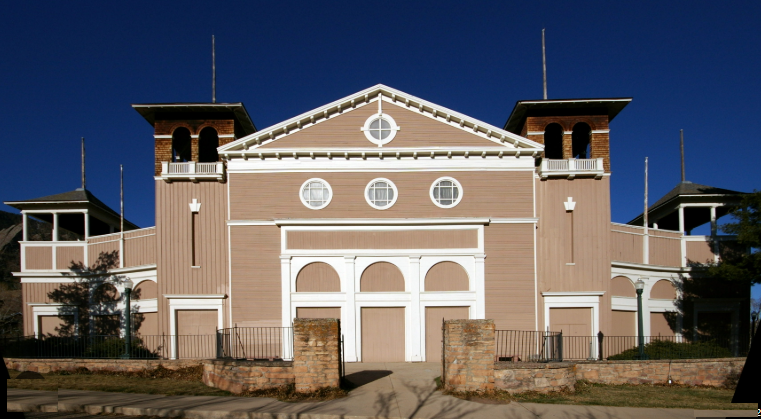
Chautauqua Auditorium in Boulder, Colorado — the 1898 wooden auditorium's front elevation with twin Victorian belltowers and arched entrance arcade
The Chautauqua Auditorium — the 1898 wooden hall where William Jennings Bryan once spoke, still hosting summer concerts and silent films today.
Flatirons Luxury · National Historic Landmark

Chautauqua & Baseline

A highly sought-after lifestyle blending historic charm with immediate access to 40 miles of Boulder open-space trails right at the doorstep. Residents enjoy a serene mountain-village feel with unmatched proximity to both the iconic Flatirons and the vibrancy of downtown Boulder. Founded in 1898, the Colorado Chautauqua is the only continuously operating Chautauqua west of the Mississippi River and is a designated National Historic Landmark.

Housing stock spans turn-of-the-century cottages, restored Tudor and Craftsman-era homes, and contemporary architect-designed properties — many with unobstructed Flatirons views. The neighborhood sits conveniently between the core of downtown Boulder and the University of Colorado main campus. Inventory is scarce and view-driven, with strong long-term value supported by Boulder's open space protections.

Historic Architecture & Landmarks
Chautauqua Auditorium (1898) On the National Register; voted one of the top ten places artists love to play. William Jennings Bryan once spoke here.
Chautauqua Dining Hall (1898) Open year-round, offering cuisine in a landmark dining setting at the base of the Flatirons.
Academic Hall (1900) Housed Colorado's first collegiate-level summer school; now home to the Chautauqua administrative offices.
Community House (1918) A stunning example of Arts and Crafts architecture, winterized and renovated for year-round community use.
Gateway to the Flatirons
Trail head ↑
Chautauqua Trailhead
The launching point for Boulder's most popular hikes — Royal Arch, First and Second Flatirons, Bluebell Mesa, and the Mesa Trail south to Eldorado Canyon. Going for a world-class hike is as simple as stepping out your front door.
Cultural →
Year-Round Programming
Exclusive walkable access to the Chautauqua Auditorium's year-round arts programming, silent films, lecture series, and community events. Plus the historic Chautauqua Dining Hall just steps away.
Historic Designation
National Historic Landmark — what buyers should know

Chautauqua Park itself is a National Historic Landmark (designated 2006) and on the National Register of Historic Places (added 1978). Some surrounding residential properties fall within the Chautauqua Park Historic District overlay; exterior modifications on protected blocks may require Landmark Alteration Certificate (LAC) approval from Boulder's Landmarks Board.

The same protections that limit modifications also support permanent long-term real estate value — foothill-adjacent neighborhoods with view easements and open-space buffers carry premiums that resist broader market downturns.

Top nearby schools Chautauqua and Baseline addresses are primarily served by Flatirons Elementary (a small neighborhood K-5 school nestled beneath the Flatirons within walking distance of Chautauqua Park, CU, and downtown), Manhattan Middle School, and Boulder High School. Verify your specific address with BVSD SchoolFinder before relying on assignments.
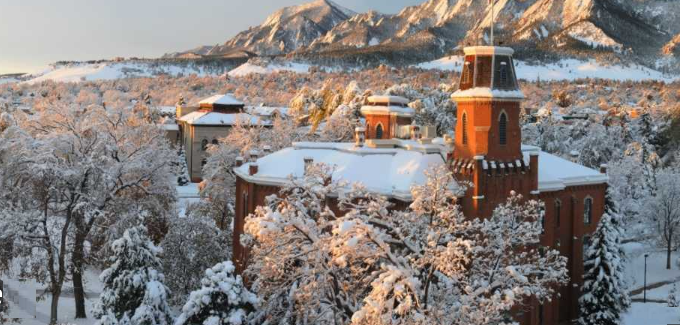
University of Colorado Boulder campus in winter — Old Main's red sandstone turrets and snow-covered Flatirons rising behind, viewed from the University Hill neighborhood
Old Main on CU's campus — the destination at the end of every 5-to-10-minute walk from the Hill, captured here after a heavy winter snow.
Walk to Campus · Counterculture Roots

University Hill ("The Hill")

Universally known as "The Hill," this is the dense, energetic neighborhood located immediately west of the University of Colorado Boulder campus. The Hill has a greater concentration of college-enrolled residents than 99.6% of U.S. neighborhoods — a five- to ten-minute walk to central CU, classic Greek Row energy, and game-day Saturdays you can hear from a mile away.

For investor-buyers and CU-adjacent owner-occupants, the Hill is one of Boulder's most distinctive markets. Inventory mixes Victorian-era homes, mid-century modern classics, restored bungalows, and student rental properties at varying scales. The commercial strip along 13th Street is the Hill's own social hub, anchored by the historic Fox Theatre.

Historic Counterculture & Character
Boulder's 1960s rock & roll heart The Hill was the epicenter of Boulder's counterculture movement in the 1960s and 1970s. The legendary Tulagi music venue hosted major touring acts during the era's prime.
Greek Row legacy The neighborhood features Boulder's highest density of fraternity and sorority houses — a defining piece of the Hill's classic college-town atmosphere.
Meditation in former frat houses During the same era, several former fraternity buildings on the Hill were converted into Buddhist meditation communities — a quintessentially Boulder pivot.
Eclectic housing mix Victorian-era homes, mid-century modern classics, restored bungalows, and a substantial private student housing market.
Campus & Commercial Lifestyle
Walk →
CU Boulder Campus
5 to 10 minutes on foot to central campus — the most CU-proximate residential neighborhood in Boulder. Game-day Saturdays bring an electric, tight-knit community energy across the entire Hill.
Step out →
The 13th Street commercial strip
Fast-casual eateries, coffee shops, retail, and the historic Fox Theatre — one of Boulder's most-loved independent music venues. The Hill is its own social district, distinct from downtown.
A Local Legend
Astronaut Scott Carpenter grew up here

The neighborhood's most famous childhood resident is Mercury 7 astronaut Scott Carpenter — the second American to orbit Earth (May 24, 1962, aboard the Aurora 7 capsule). Carpenter grew up at the corner of Aurora Avenue and 7th Street here on the Hill, attended University Hill Elementary as a child in the 1930s, and later graduated from Boulder High and CU Boulder's aeronautical engineering program.

While Carpenter publicly denied that his spacecraft "Aurora 7" was named after the Boulder street he grew up on, the coincidence remains one of Boulder's favorite pieces of local lore. The Aurora 7 neighborhood east of campus — and the Aurora 7 Elementary located there — both take their names from his Mercury capsule.

Top nearby schools University Hill is a CU-adjacent neighborhood, so most residents are CU students, faculty, or owner-occupied investors rather than families with school-age children. For K-12 families considering the Hill: University Hill Elementary (founded 1906, located at 956 16th Street in the neighborhood) is a celebrated Spanish-English dual-language focus school — but it has no attendance area and is open to any BVSD family via the open enrollment lottery, not by address. Residential addresses on the Hill are typically zoned to Flatirons Elementary (which also serves Chautauqua) or other nearby neighborhood schools depending on the specific block, then feed into Manhattan Middle and Boulder High. Always verify your address with BVSD SchoolFinder before relying on assignments.
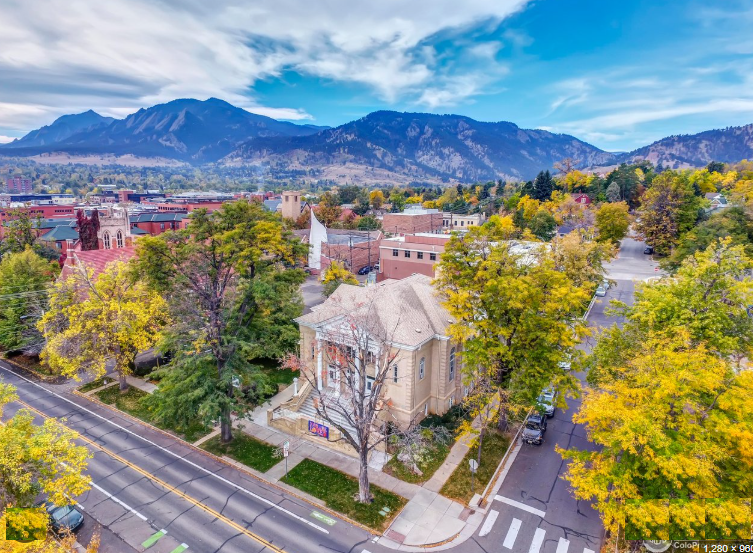
Whittier neighborhood in central Boulder, Colorado — aerial autumn view of historic architecture along tree-lined streets with the Flatirons rising in the background
Whittier in peak autumn — historic architecture, golden tree canopy, and the Flatirons framing the western horizon just beyond downtown.
Historic · East of Pearl

Whittier

One of Boulder's oldest and most historically significant neighborhoods, Whittier sits east of downtown with the kind of small-town walkability that makes it consistently rank among Boulder's most coveted addresses. Tree-lined streets, beautifully preserved Victorian homes alongside modern custom builds, and a charming, slightly quirky residential character distinguish it from neighborhoods elsewhere in the city.

The neighborhood centers on Whittier International Elementary School at 2008 Pine Street — Colorado's oldest continuously operating school, built in 1882. Whittier offers some of the best walkability and bike infrastructure in Boulder (Walk Score 89, Bike Score 100), sits less than a mile north of CU Boulder, and bridges quiet residential streets with direct access to Pearl Street, the Twenty Ninth Street shopping mall, and the city's farm-to-table dining scene.

Historic & Cultural Character
Colorado's oldest school (1882) Whittier International Elementary is a designated Historic Landmark — Colorado's oldest continuously operating school, originally named the Pine Street School after its address.
How the school got its name In 1903 a 6th-grade student named Effie Titus wrote a fan letter to poet John Greenleaf Whittier about his poem "Snowbound." The poet wrote back, and the school was renamed in his honor.
Victorian housing stock Beautifully preserved Victorian-era homes line the neighborhood's tree-canopied streets, alongside Craftsman bungalows and carefully integrated modern custom builds.
An eclectic, artistic spirit Whittier is known for its quirky front-yard sculptures and locally famous Halloween installations — like the Pearl Street Haunt — that give it a distinct artistic personality.
Walkability & Pocket Parks
Walk · Bike →
Pearl Street & Twenty Ninth Street
Walk Score 89, Bike Score 100 — among the highest in Boulder. Easy walking or biking distance to Pearl Street's restaurants and shops, plus the Twenty Ninth Street shopping mall just east of the neighborhood.
View ↑
Lover's Hill & Pocket Parks
Whittier's green space is distributed across small pocket parks rather than one large one. Lover's Hill Park offers sweeping views of downtown Boulder and the Flatirons from a quiet residential perch.
Top nearby schools Whittier addresses are served by Whittier International Elementary (Colorado's oldest continuously operating school, located right in the neighborhood at 2008 Pine Street, featuring an inquiry-based International Baccalaureate curriculum), Casey Middle School, and Boulder High School. Verify your specific address with BVSD SchoolFinder before relying on assignments.
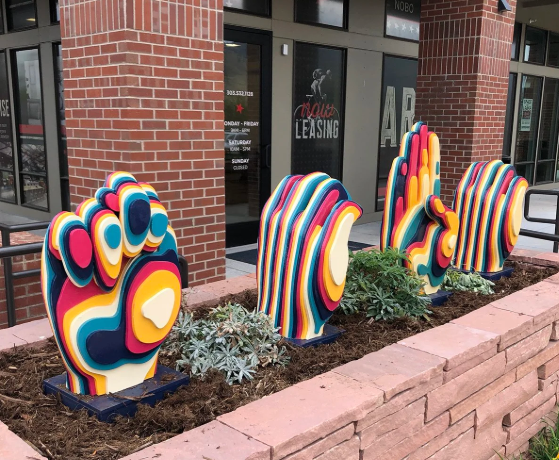
NoBo Art District in North Boulder, Colorado — colorful multicolored sculptural hands as public art outside mixed-use storefronts in the city's creative arts hub
Public art in the NoBo Art District — the kind of street-level creative energy that earned North Boulder its "Brooklyn of Boulder" reputation.
Arts District · Growth Area

North Boulder ("NoBo")

North Boulder — universally known as "NoBo" — is the city's most diverse, creative, and rapidly evolving neighborhood. What was once a working industrial zone north of Iris Avenue has transformed over the last 20 years into Boulder's unofficial arts hub: galleries, studios, breweries, and the kind of grassroots independent energy that's earned it the affectionate "Brooklyn of Boulder" nickname.

For buyers, NoBo offers something rare in Boulder: a genuine mix of housing scales and price points, from historic 1900s cottages to brand-new modern townhomes in Dakota Ridge and along the developing Broadway corridor. The neighborhood draws residents looking for vibrant, tight-knit community, abundant open space, easy foothills access, and a creative-class energy that Boulder's more established southern districts can't quite replicate.

The NoBo Arts & Culture Identity
NoBo Art District A Colorado Creative District designation, with dozens of galleries, working studios, and creative-class businesses concentrated along North Broadway.
First Friday Art Walks Monthly evening events where studios open to the public, food trucks line the streets, and visitors meet the artists working in the neighborhood.
NoBo Library & Studio 24 A vibrant North Boulder library branch featuring a musical walkway, the "Studio 24" makerspace (screen printing, digital design), and an outdoor maker space for community gatherings.
Boulder's most diverse blocks The area east of Broadway holds Boulder's largest Latinx population, adding cultural and culinary diversity that distinguishes NoBo from neighborhoods elsewhere in the city.
Outdoor Access & Daily Life
Trail head ↑
Wonderland Lake & the Foothills
Direct access to Wonderland Lake Park (a scenic in-city lake with surrounding trails) and the north end of Boulder's open space trail network. The Goose Creek Path provides safe, car-free transit east to the Valmont Bike Park and beyond.
Walk · Bike →
Ideal Market & North Boulder Rec Center
The Ideal Market complex anchors the daily-life amenity layer (groceries, cafes, locally-owned shops). The North Boulder Recreation Center offers indoor and outdoor pools, fitness classes, and community gardens.
Where the City Is Growing
Mixed housing scale, mixed price points

NoBo is one of Boulder's most actively developing neighborhoods, with new mixed-use projects, modern townhome developments in Dakota Ridge, and infill multi-family construction continuing along the Broadway corridor. Established blocks closer to Wonderland Lake retain a quieter, single-family character.

The combination of more accessible entry prices, ongoing development upside, and Boulder's broader supply constraints makes NoBo one of the more dynamic submarkets in the city — popular with both first-time Boulder buyers and longer-tenure residents priced out of the historic districts.

Top nearby schools North Boulder addresses are served by elementary schools that include Columbine Elementary, Crest View Elementary, and Foothill Elementary, depending on the specific block. Older students typically feed into Casey Middle or Centennial Middle, then Boulder High School — not Centaurus (Centaurus High is in Lafayette and serves a different feeder pattern). BVSD is making elementary boundary adjustments effective 2026–27 in the north Boulder area, so always verify your specific address with BVSD SchoolFinder before relying on assignments.
For parents & investors

Buying a CU condo for your student

For parents and investors weighing a condo or small property within walking distance of the CU Boulder campus — three CU-adjacent neighborhoods worth knowing. These corners of Boulder real estate typically come with lower entry points than Boulder's primary residential districts above, plus the option to rent the unit out after graduation or hold for long-term appreciation in one of the most supply-constrained college towns in the country.

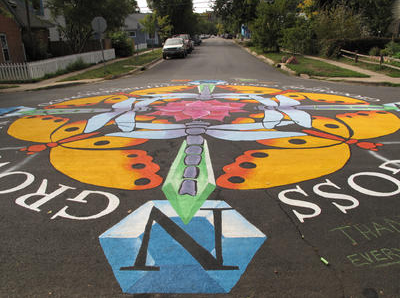
Goss-Grove neighborhood in Boulder, Colorado — colorful hand-painted street mural with a butterfly and the neighborhood name across an intersection
The Goss-Grove street mural — hyper-local public art identifying the small CU-adjacent enclave by name.
Walk to Pearl & Campus

Goss-Grove

A small historic enclave east of downtown and just north of CU's campus. Walking distance to both Pearl Street and CU classrooms. Mix of small Victorians, bungalows, and converted multi-family rentals — long popular with grad students, faculty, and small landlords.

Typical condo $400k–$650k
To CU campus 5–10 min walk
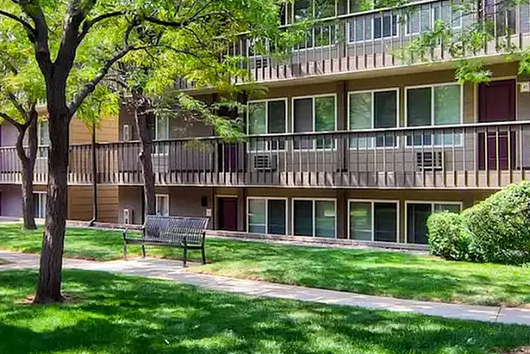
Martin Acres neighborhood in South Boulder, Colorado — three-story garden-style condo building with wood-clad balconies, mature tree canopy, and a bench on a landscaped walkway
A garden-style Martin Acres condo building — the kind of mid-century inventory that anchors this established south-of-CU neighborhood.
South of CU · Established

Martin Acres

An established south Boulder neighborhood just below CU's main campus, with a mix of 1950s-era single-family homes, townhomes, and condo developments. More affordable than Newlands or Mapleton Hill, with strong rental demand from grad students and young professionals.

Typical condo $450k–$700k
To CU campus Quick bike ride
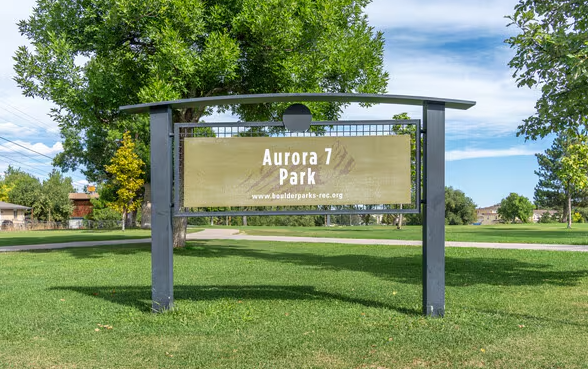
Aurora 7 Park in Boulder, Colorado — official City Parks & Rec identification sign for the neighborhood park named after Scott Carpenter's 1962 Mercury capsule
Aurora 7 Park — named, along with the neighborhood and its elementary school, after Scott Carpenter's 1962 Mercury capsule.
East of CU · Condo-rich

Aurora 7

A peaceful Boulder neighborhood southeast of The Hill, named (along with its elementary school) after Scott Carpenter's Aurora 7 Mercury capsule. Anchored by Aurora 7 Park, the north end along Colorado Avenue is condo-and-townhouse heavy — lower entry points, walk-and-Buff-Bus access to campus, and a steady pipeline of student and grad-student renters. Unobstructed Flatirons views from many units.

Typical condo $300k–$500k
To CU campus ~10 min walk or bus

Price ranges shown reflect general spring 2026 condo market activity by neighborhood and are starting points for conversation, not appraisals. Investment property and parent-buyer scenarios involve tax, financing, HOA, and city short-term rental considerations that we walk through individually. Reach out to discuss your specific timeline and budget.

Browse available homes

Browse Boulder real estate listings

Search all current Boulder homes for sale by price band below, or view every live Boulder Colorado real estate listing on the full MLS-powered search. Inventory updates in real time.

Where Boulder sits

Boulder County, at the base of the Flatirons

30 miles northwest of Denver, 15 miles south of Longmont, and pressed directly against 45,000 acres of protected open space and the Flatirons rock formations. The city you can't sprawl out of.

Map data © OpenStreetMap contributors · View larger map →

Frequently asked

Boulder real estate, answered

The questions buyers, sellers, and anyone moving to Boulder ask most often about Boulder real estate.

The median sale price in Boulder ranges from approximately $819,000 to $1,000,000 in spring 2026 depending on the source, with single-family homes commonly $1.2 million to $1.5 million and condos and townhomes typically $450,000 to $550,000. Boulder's prices vary widely by neighborhood — Mapleton Hill, Chautauqua, and Newlands command premiums well above the citywide median, while Table Mesa, Whittier, and parts of North Boulder offer more accessible price points. Homes are selling in 39 to 52 days on average with a sale-to-list ratio near 96 to 97 percent.

Boulder is structurally supply-constrained. The city was the first in the United States to tax itself to buy open space (1967), now protecting more than 45,000 acres surrounding the city. A height-limit ordinance keeps most buildings to 35 feet, preventing high-rise density. Boulder also limits annual residential growth through the Residential Growth Management System. Combined with the University of Colorado, federal labs like NIST and NOAA, and a steady influx of tech and biotech employees, demand consistently outpaces new supply — which keeps prices high and inventory tight.

For families, the most-recommended Boulder neighborhoods include Newlands (northwest Boulder with direct Mount Sanitas trail access and top-rated schools), Table Mesa (south Boulder with NCAR and Mesa Trail access, served by Fairview High), and North Boulder (newer development, more affordable for the city, with growing family infrastructure). Whittier and parts of central Boulder also work well for families who prioritize walkability over space. All Boulder public schools are part of Boulder Valley School District (BVSD), one of Colorado's top districts.

Boulder is served by Boulder Valley School District (BVSD), which operates 56 schools across Boulder and surrounding communities and consistently ranks among Colorado's top districts. BVSD attendance areas are address-specific, so the elementary, middle, and high school your home is zoned for depends on the property — use BVSD's SchoolFinder tool to verify. The two main Boulder high schools are Boulder High (downtown and central) and Fairview High (south Boulder). BVSD also operates focus schools like High Peaks Elementary (Core Knowledge) and Community Montessori, which accept students from anywhere in the district via the choice enrollment lottery.

Boulder is the only U.S. city that taxed itself specifically to conserve open space, the first ever to do so in 1967. The city is the home of the University of Colorado, four federal labs (NIST, NOAA, NCAR, and the National Renewable Energy Laboratory nearby in Golden), and consistently has one of the highest concentrations of PhDs per capita in the country. Boulder sits at the base of the iconic Flatirons rock formations — and the face of the Third Flatiron at over 1,400 feet is taller than the Empire State Building's roof. The city also has one of the highest per-capita concentrations of used bookstores in the United States and one of America's earliest pedestrian malls, the Pearl Street Mall, which opened in 1977.

Yes, but homes within Boulder's official historic districts — including Mapleton Hill, Chautauqua, Whittier in some sections, and the Downtown Historic District — require a Landmark Alteration Certificate (LAC) from Boulder's Landmarks Board for any exterior change. This includes window replacement, paint color in some cases, fence changes, accessory buildings, and structural modifications. Interior renovations generally do not require LAC approval. Colorado offers a 20 percent state income tax credit on qualified historic rehabilitation expenses up to $50,000 per property, and Boulder waives sales tax on certain exterior construction materials for historic homes — both of which offset some of the preservation cost burden.

Homes in Boulder are currently selling in 39 to 52 days on average in spring 2026, with a sale-to-list ratio near 96 to 97 percent. Well-prepared and accurately priced homes in desirable neighborhoods can go under contract faster — especially in supply-constrained districts like Mapleton Hill and Chautauqua, where listings often draw multiple offers within the first week. Overpriced listings can sit on the market 80 days or longer. Boulder is currently a more balanced market than during the 2021 to 2022 frenzy, which means presentation and accurate pricing matter more than they did during peak years.

In 1967, Boulder became the first U.S. city to pass a dedicated sales tax for open space acquisition. The city has since protected more than 45,000 acres of open space and mountain parks surrounding it. This creates a hard geographic growth boundary — Boulder cannot expand outward like other Front Range cities. Combined with a 35-foot height-limit ordinance and the Residential Growth Management System, this structurally limits housing supply and contributes to Boulder's higher home prices. The same protections create a permanent real estate premium — properties near foothills and open space carry value that resists broader economic downturns.

Skip to content
What Clients Say

Trusted by Front Range Families

5.0
Based on 9 Google Reviews
Joanne T. Verified Google Review

We absolutely loved working with our agent! She was not only knowledgeable and professional but also genuinely caring throughout the whole process. She took the time to understand exactly what we were looking for and made the home-buying experience fun and enjoyable. We felt like we were in great hands from start to finish. Highly recommend if you want a realtor who truly cares!

Response from our team

Thank you Joanne! I had such a great time working with you guys.

Hannah R. Verified Google Review

If you are on the fence about using a realtor to buy or sell your home, this is the kind of realtor you want. She prioritizes client satisfaction above all else, and goes above and beyond to take care of you as if you were her own family. She stays current on market and contract education to help you get the most out of your deal, and is easily reachable and accommodating with other realtors and lenders involved to ensure a smooth and timely closing process. Would highly recommend!

Response from our team

Awe thank you Hannah!

Heather C. Verified Google Review

Our agent goes beyond being a realtor; she's a friend. Her expertise, friendly demeanor, and hardworking nature make her an asset in your real estate journey. You have a dedicated professional who not only understands real estate but is also committed to making your experience smooth and enjoyable.

Response from our team

I appreciate it, Heather!

Brie J. Verified Google Review

You will be so glad you picked this realtor to help you in your home buying process! She has a very warm and caring presence as well as knowledgeable and thorough work ethic. Buying a home is such an exciting but overwhelming experience — having a trustworthy realtor on your side is a must! You will be happy you called.

Response from our team

Thanks Brie. I appreciate your kind words.

David P. Verified Google Review

Our agent has her client's best interest in mind and keeps working to ensure they have a great homebuying experience. She's engaged throughout the process with a high level of communication which makes for happy clients and a smooth transaction.

Response from our team

Thank you for the kind words, David!

Brandon H. Verified Google Review

Our agent was so incredibly helpful and patient with us as we navigated the home buying process. She never pushed us to make a decision but was there to answer any questions and supportive every step of the way. Not only did we close quickly, but we felt confident every step of the way.

Response from our team

Awe! Thanks Brandon! I am so glad you had a good experience.

Janet M. Verified Google Review

Our family used this agent as a realtor and she was fantastic. She worked diligently to find the perfect home. I highly recommend the next time you need a realtor.

Response from our team

Thank you Jan!

Marty H. Verified Google Review

Our agent is a wonderful person and does a wonderful job at getting answers, returns calls, and the best at her job! Highly recommend!

Response from our team

Thanks Marty!

Melanie K. Verified Google Review

Our agent is such a kind soul that will really work hard for you!

Response from our team

Thanks Mel! You know it!

Jaime Looger, Broker Associate at Your Castle Real Estate, serving Longmont and the Front Range
Meet your guide

Jaime Looger

Broker Associate · Your Castle Real Estate · Longmont, CO

100% Client-Focused
50+ Families Helped
5.0 9 Google Reviews

"Buying or selling a home isn't just a transaction — it's a life-changing experience. I take care of my clients as if they were family, because your goals become my goals."

CO License #FA100098781 Your Castle Real Estate REcolorado MLS Member
Scroll to Top