Boulder1967
First U.S. city to tax itself for open space
In 1967, Boulder became the first city in the United States to pass a dedicated sales tax to acquire and preserve open space. The program has since protected more than 45,000 acres surrounding the city — creating a hard geographic growth boundary that no other Front Range city has.
BoulderFlatirons
An icon taller than the Empire State Building
The face of the Third Flatiron rises more than 1,400 feet from base to summit — taller than the Empire State Building's roofline (1,250 feet). Boulder is one of the only U.S. cities where a rock formation in the city limits is taller than New York's most famous skyscraper.
BoulderCulture
America's highest per-capita used bookstore density
Boulder has consistently ranked among the cities with the highest per-capita concentration of used bookstores in the United States. Pair that with 5 federal labs, the University of Colorado, and one of the highest PhDs-per-capita rates in the country — and you get a city that takes reading seriously.
Boulder's oldest standing home
The Squires-Tourtellot House at 1019 Spruce Street was built in 1865 from local river rock and fieldstone with 20-inch-thick walls. It was the first building ever landmarked by the City of Boulder — predating the city's incorporation by six years.
A neighborhood built around a school
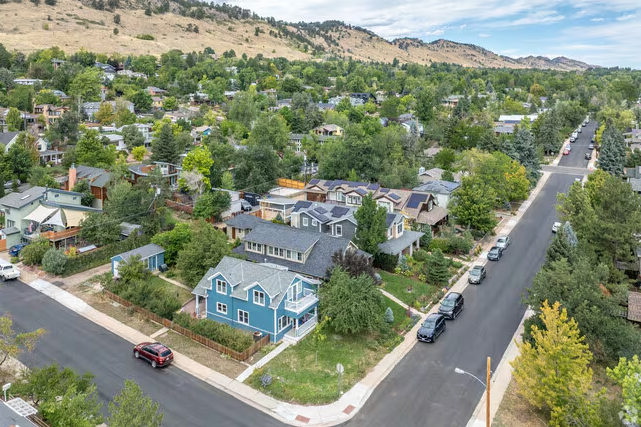
Unlike most developments that add schools later, Mapleton Hill's very first building was the Mapleton School in 1888. The neighborhood grew up around it. The building still operates as a school today — over 135 years later.
The accidental cathedral canopy
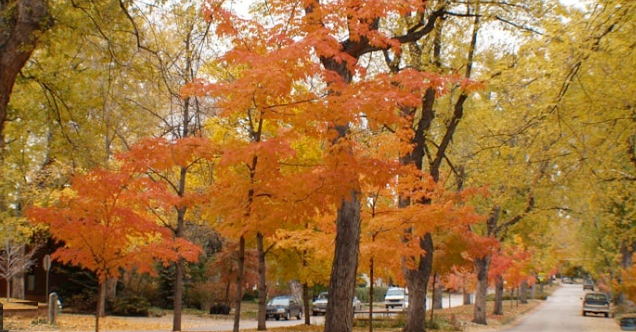
In the 1880s, developers planted more than 200 silver maple and cottonwood trees on what was then a barren, windswept hill. Famed landscape architect Frederick Law Olmsted Jr. later dismissed silver maples as too brittle — "a poor choice." More than a century later, the trees still stand, creating a rare East-Coast-style cathedral canopy in the Mountain West.
The Wedding Cake House
1020 Mapleton Avenue earned its nickname from an elaborate, multi-tiered Colonial Revival design that resembles tiers of a wedding cake. One of Boulder's most photographed homes — and a benchmark for the architectural ambition that defines the historic district.
One of America's earliest pedestrian malls
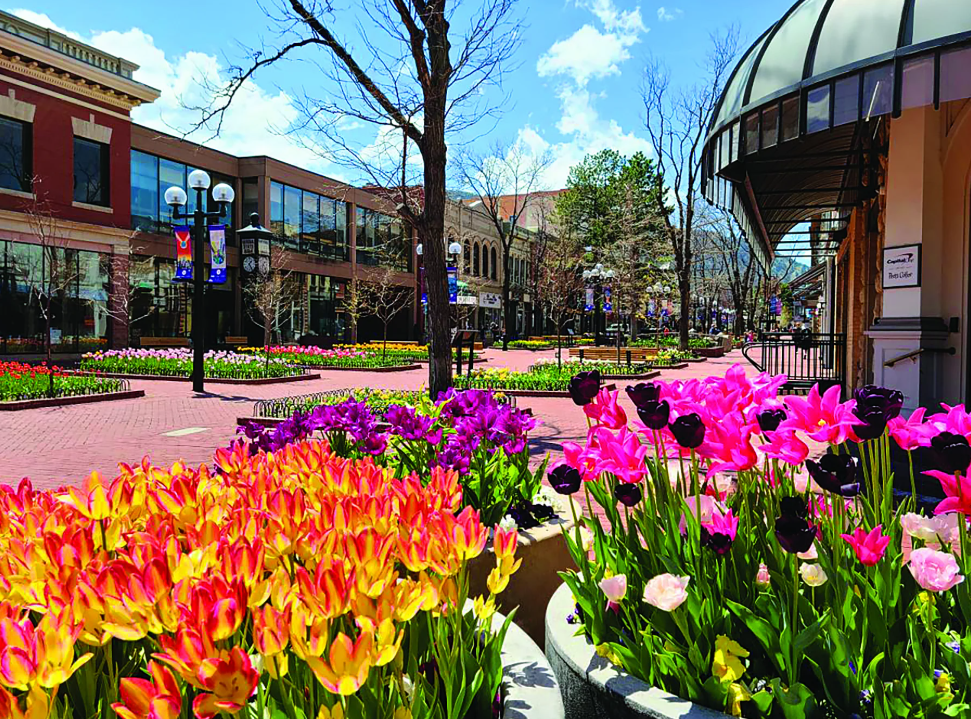
The Pearl Street Mall opened in 1977, making it one of the earliest pedestrian-only retail districts in the United States. Four blocks of historic buildings, street performers, public art, and locally-owned businesses — it's been the heart of Boulder for nearly five decades.
Pearl Street is officially a city park
The four-block car-free strip of Pearl Street isn't classified as a shopping center, a plaza, or a public square — it's officially designated as a City of Boulder park. Bands on the Bricks summer concerts, pop-jet fountains, public rock gardens, and street performers all happen on what is, legally, parkland.
The first paved road in Boulder
Pearl Street was the first road ever paved in Boulder, in 1917. The bricks underfoot — replaced and restored multiple times since the 1977 pedestrian-mall redesign — literally cover Boulder's earliest piece of modern paved infrastructure.
Generations of independent businesses
Pearl Street is home to multi-decade Boulder institutions: Hurdle's Jewelry has operated since 1947, Boulder Bookstore since 1973, and Into the Wind (the kite and toy shop) for decades. In an era when most American downtowns turn over rapidly, Pearl Street's tenant longevity is one of the longest in the country.
An I.M. Pei masterpiece above the neighborhood
The NCAR Mesa Lab, sitting at the top of Table Mesa, was designed by modernist architect I.M. Pei (later famous for the Louvre Pyramid). Completed in 1967, the bush-hammered poured-concrete structure was designed to feel like a natural extension of the Flatirons behind it — one of Pei's most respected institutional buildings, and the visual anchor of South Boulder.
A shopping center built around its trees
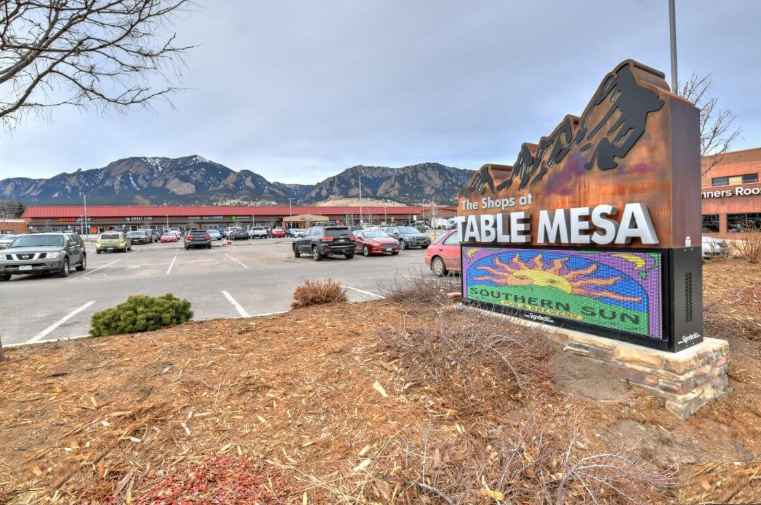
When the Table Mesa Shopping Center was developed in the early 1960s, the architects didn't clear the existing trees — they designed the structure around them. Two massive original trees still pierce through the shopping center's roof line today, a living tribute to the neighborhood's pre-development character.
Founded for Texas teachers escaping the heat
The Colorado Chautauqua was originally created as a summer school destination for educators from Texas seeking a cool mountain climate. The governing nonprofit was formerly known as the Texas-Colorado Chautauqua Association — the only chapter of the national 19th-century Chautauqua adult-education movement to take root west of the Mississippi River.
The last Chautauqua west of the Mississippi
The Colorado Chautauqua is the only Chautauqua west of the Mississippi River still in unbroken operation since the heyday of the Chautauqua Movement in the 1920s. Designated a National Historic Landmark in 2006, it joins just a small number of original Chautauquas nationwide still operating with their 19th-century structures intact.
Where William Jennings Bryan spoke
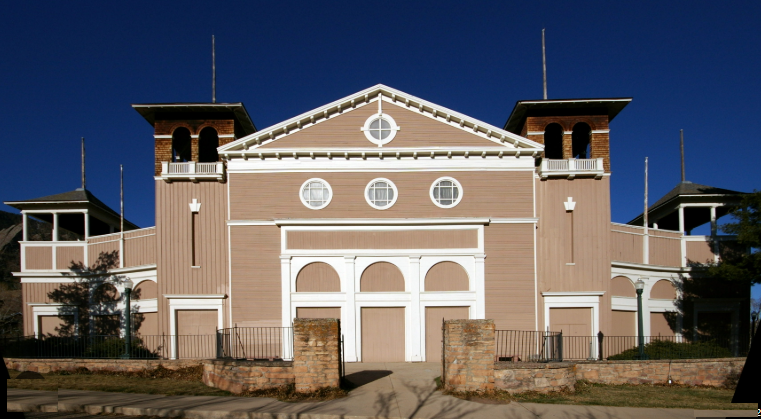
The Chautauqua Auditorium (1898) hosted some of America's most famous orators in its heyday, including three-time presidential candidate William Jennings Bryan. The wooden hall is voted among the top ten places artists love to play because of its superior acoustics and intimate feel — still hosting summer concerts and silent-film screenings today.
More college students per block than 99.6% of America
"The Hill," the neighborhood immediately west of the CU Boulder campus, has a greater concentration of college-enrolled residents than 99.6% of all U.S. neighborhoods. Greek Row, restored Victorians, and converted student rentals fill the streets — a five- to ten-minute walk from central campus.
Boulder's rock & roll counterculture epicenter
During the 1960s and 70s, the Hill was the center of Boulder's rock-and-roll and counterculture movements. The legendary Tulagi music venue hosted major touring acts — and in the same era, several former fraternity houses were converted into Buddhist meditation communities, a pivot that remains classically Boulder.
The astronaut who grew up at 7th & Aurora
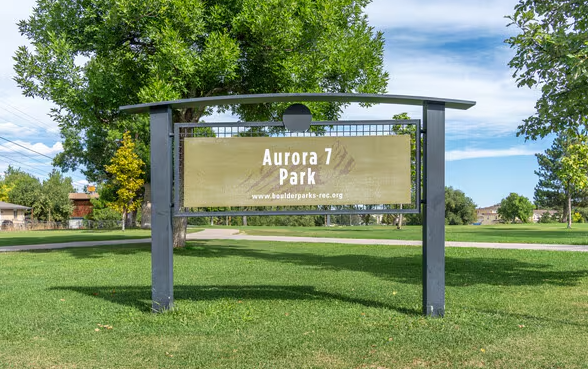
Mercury 7 astronaut Scott Carpenter — the second American to orbit Earth aboard the Aurora 7 capsule in 1962 — grew up at the corner of Aurora Avenue and 7th Street on the Hill. He attended University Hill Elementary as a child (where he reportedly carved a wooden toy train for a classmate in 1934) before graduating from Boulder High and CU's aeronautical engineering program. Aurora 7 Elementary in the Aurora 7 neighborhood east of campus is named for his spacecraft.
Colorado's oldest continuously operating school
Whittier International Elementary at 2008 Pine Street, originally the Pine Street School, opened in 1882 with 135 students in four classrooms. More than 140 years later it's still operating, making it the oldest continuously operating school in Colorado. The building itself is a designated Historic Landmark.
A 6th-grader, a fan letter, and a renamed school
In 1903, a 6th-grade student named Effie Titus wrote a fan letter to poet John Greenleaf Whittier about his poem "Snowbound." Whittier wrote back, beginning a correspondence between the poet and the school — and the Pine Street School was renamed in his honor. The neighborhood took its name from the school. A 12-year-old's pen pal letter is how an entire Boulder neighborhood got its identity.
NoBoThe "Brooklyn of Boulder"
From industrial zone to Colorado Creative District
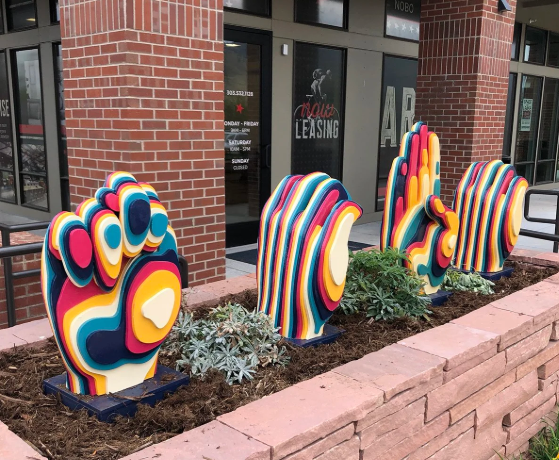
North Boulder ("NoBo") evolved over the last 20 years from a working industrial corridor north of Iris Avenue into Boulder's unofficial arts hub — earning the nickname "the Brooklyn of Boulder." The NoBo Art District is officially designated a Colorado Creative District, with dozens of galleries, working studios, and monthly First Friday art walks where the public meets the artists.
Boulder's most culturally diverse neighborhood
The blocks of North Boulder east of Broadway hold the largest Latinx population in Boulder, adding cultural and culinary diversity that distinguishes NoBo from neighborhoods elsewhere in the city. In a city often criticized for demographic homogeneity, NoBo is a meaningful exception.
A lake inside the city, ringed by foothills trails
Wonderland Lake Park sits inside North Boulder — a scenic urban lake with surrounding trails that connect directly to the foothills open space network. Residents can walk out the front door to a foothills hike or a quiet lakeside picnic, which is rare even by Boulder's high outdoor-access standards.
BoulderToday
Five federal labs and a PhD city
Boulder hosts NIST (atomic clock and time-standard research), NOAA (weather and climate), NCAR (atmospheric research, in I.M. Pei's iconic mesa building), the Joint Institute for Laboratory Astrophysics, and supports the National Renewable Energy Lab in nearby Golden. Combined with CU Boulder, this gives the city one of the highest concentrations of PhDs per capita in America.
Boulder's strawberry-and-fruit farm
Newlands is named for the Newland family, who established a large fruit and strawberry farm here in the 1870s. When Mary Newland began selling parcels to developers in the 1890s and early 1900s, the orchard heritage stayed embedded in the neighborhood's character — and in some of its still-standing original homes.
An apple tree on every lot
Local lore holds that the Newland family planted an apple tree on every parcel they sold off, hoping to add value and signal abundance to potential buyers. Some of those trees are believed to still bear fruit on Newlands lots today — living artifacts of the neighborhood's agricultural beginnings.
One of Boulder's most organized neighborhoods
Newlands is one of the only Boulder neighborhoods with its own hyper-local volunteer community organization. Active social media pages coordinate seasonal events, garden tours, and neighborhood initiatives — a level of grassroots civic infrastructure rare in a city of Boulder's size.